New & Now
Sumo Column Vol.1: Yokozuna and the Banzuke in Grand Sumo
Sumo (相撲) is often described as Japan’s national sport and is a traditional form of wrestling with a history of over a thousand years. In 2025, the Nihon Sumo Kyokai(Japan Sumo Association) marked the 100th anniversary of its foundation. To mark this milestone, a special event called “Centennial Basho – Classical Sumo and Modern Grand Sumo” was held at Ryogoku Kokugikan in Tokyo on October 7 for the first time in 30 years. The two current yokozuna, Onosato (大の里) and Hoshoryu (豊昇龍), performed the powerful sandan-gamae (三段構え), a formal three-part posture ritual based on upper, middle and lower stances. This ceremony is distinct from the ordinary dohyo-iri ring-entering ceremony and is usually performed only on special occasions by the highest-ranking rikishi. A recent special Grand Sumo performance in London was also a great success.
In this first Sumo Column, we explain two key ideas in Grand Sumo: yokozuna (横綱), the highest rank for a sumo wrestler, and the banzuke (番付), the official sumo rankings list published before each Grand Sumo Tournament.
What Is a Yokozuna (横綱)?
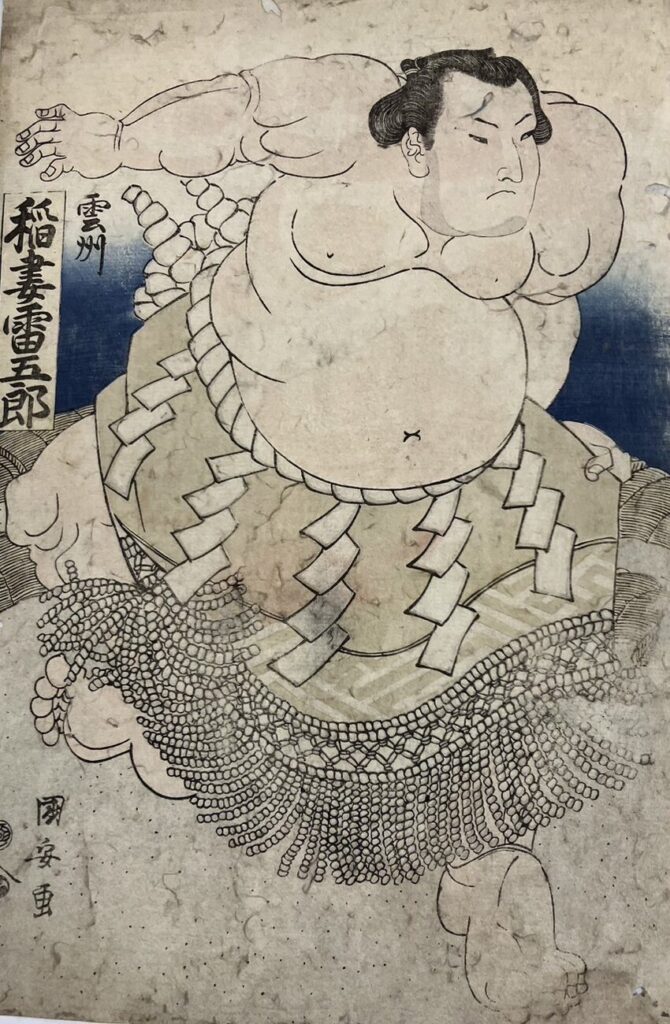
7th yokozuna Inazuma Raigoro
Held the yokozuna rank from October 1829 to November 1840
Today, some fans say that Grand Sumo has entered the “Taiho Era” (大豊時代), a nickname created by combining one kanji each from the names of the two current yokozuna, Onosato (大の里) and Hoshoryu (豊昇龍). With one yokozuna listed on the East side and one on the West side of the banzuke, Grand Sumo is attracting even more attention. In his victory interview after winning the Kyushu Tournament in November 2025, the newly promoted ozeki Aonishiki (安青錦) said, “There is still one rank above me, yokozuna, and that is what I want to aim for.” Yokozuna is the ultimate goal for every rikishi.
A yokozuna is the highest rank in modern professional sumo. Originally, however, the word yokozuna was used as a title for an ozeki who had received a yokozuna license from the Yoshida Tsukasa family (吉田司家), a hereditary family historically associated with sumo etiquette and rank. At that time, the highest rank shown on the banzuke was still ozeki.
In 1909, a separate yokozuna line was added at the very top of the banzuke, and yokozuna was officially established as an independent rank above ozeki.
Only wrestlers who possess the dignity expected of a yokozuna, together with exceptional strength, can be granted the rank. When an ozeki is considered for promotion to yokozuna, the Japan Sumo Association consults the Yokozuna Deliberation Council and makes its final decision after receiving the council’s recommendation.
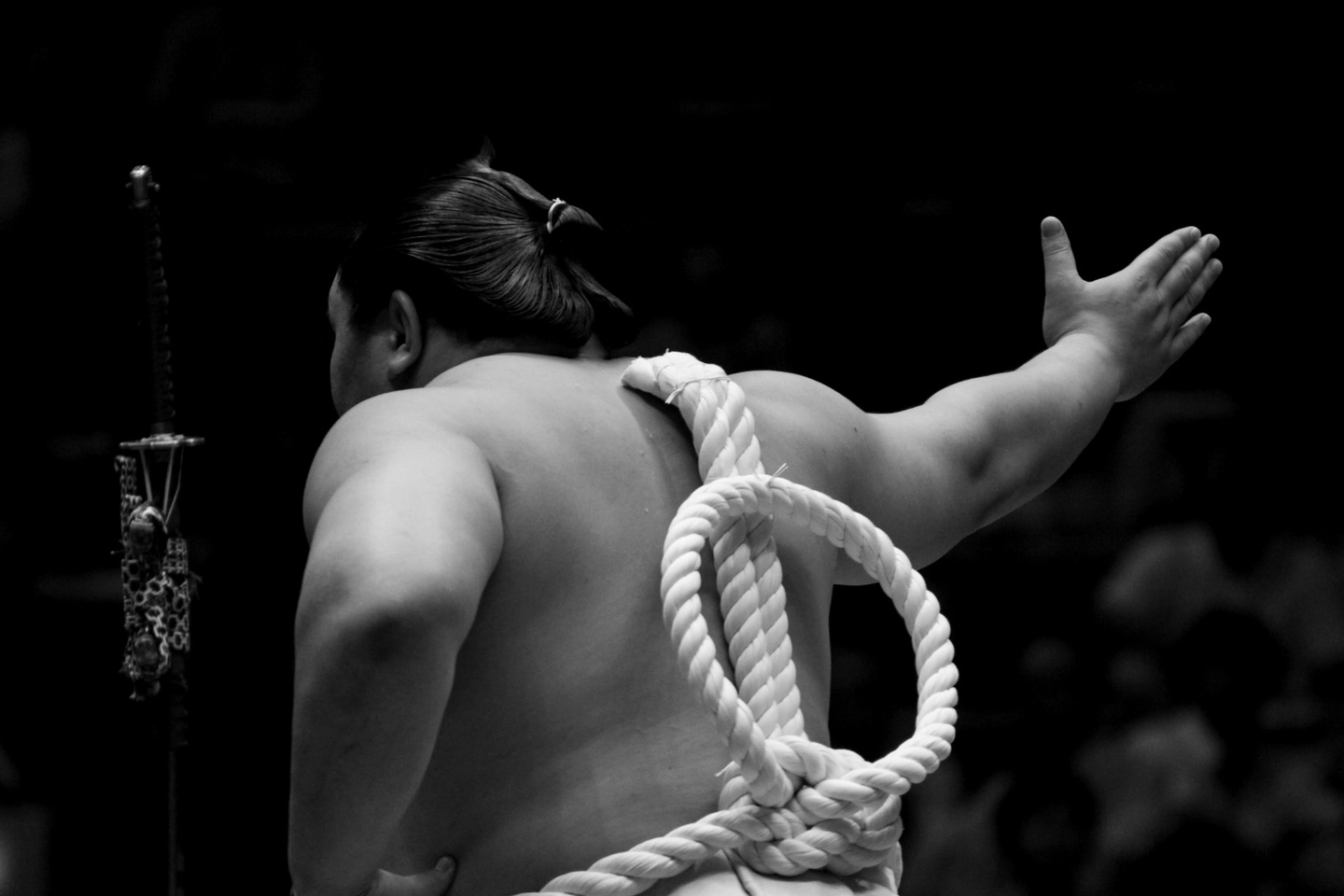
The word yokozuna is said to come from shimenawa, the sacred rope used to mark off the boundary between the realm of the gods and the human world. The name is often explained as coming from the image of a sacred rope stretched horizontally to mark off a space. The thick white hemp rope worn around a yokozuna’s waist during the ring-entering ceremony is also known as a yokozuna.
The special ring-entering ceremony performed by a yokozuna is known as the yokozuna dohyo-iri and is also called kataya-iri. A yokozuna also has an honorific nickname, hinoshita kaizan, expressing the idea that he has no equal.
Sumo Terms Used in This Section
- Yokozuna (横綱) – The highest rank in professional sumo. A yokozuna is expected to show not only exceptional strength and results, but also dignity and character worthy of the rank.
- Ozeki (大関) – The second-highest rank in professional sumo, directly below yokozuna. An ozeki who continues to achieve outstanding results may be considered for promotion to yokozuna.
- Yokozuna Deliberation Council (横綱審議委員会) – An advisory council that reviews candidates for promotion to yokozuna and also discusses matters such as retirement recommendations. Its opinions are submitted to the Nihon Sumo Kyokai(Japan Sumo Association), which makes the final decision.
- Shimenawa (注連縄) – A sacred rope used in Shinto to mark off a sacred space and separate it from the ordinary world. The word “yokozuna” is often explained in relation to this rope, and the thick white rope worn by a yokozuna during the ring-entering ceremony is also called a yokozuna.
- Yokozuna dohyo-iri (横綱土俵入り) – The special ring-entering ceremony performed only by yokozuna. It differs from the regular ring-entering ceremonies of other wrestlers and is one of the most symbolic rituals in Grand Sumo.
What Is Expected of a Yokozuna: Results and Dignity
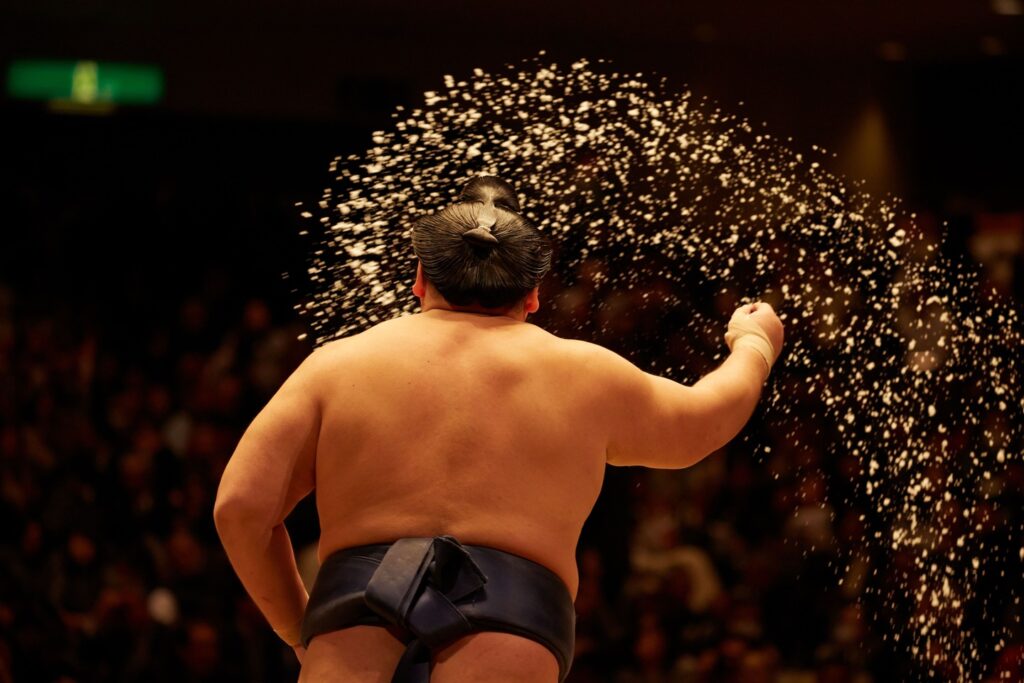
A yokozuna is expected to show outstanding strength, excellent results, and the dignity worthy of the rank. As a general guideline, promotion to yokozuna is considered when an ozeki wins two consecutive tournaments, or achieves results considered equivalent to that level.
In recent years, Hoshoryu was promoted to yokozuna on the basis of results close to the well-known benchmark of 33 wins over three tournaments. That number is often cited in discussions of promotion to ozeki. Even when a wrestler does not actually win the championship, promotion may still be considered if his results are judged to be close to a championship-level performance.
When a wrestler is promoted to ozeki or yokozuna, he gives a short formal speech called kojo at the promotion ceremony. These speeches often reflect the wrestler’s determination, goals, personality, and sense of dignity. We hope to introduce some memorable examples in a future column.
Sumo Terms Used in This Section
- Kojo (口上) – A short formal speech delivered by a wrestler at his promotion ceremony when he becomes an ozeki or yokozuna. In this speech, he expresses his determination, goals, and attitude toward his new rank.
- Championship / Yusho (優勝) – Winning a Grand Sumo Tournament with the best overall record. In promotion discussions, not only championships themselves but also performances considered equivalent to a championship may be taken into account.
List of Historic Yokozuna in Grand Sumo
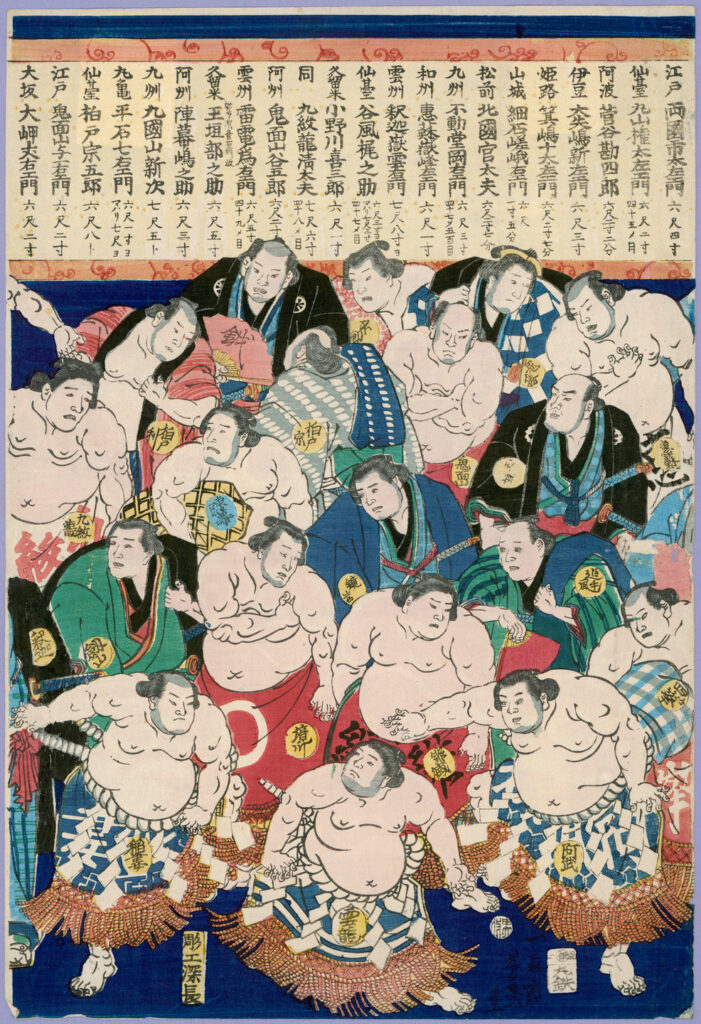
A complete list of past yokozuna can be found on the official website of the Japan Sumo Association. Starting with Akashi Shiganosuke (明石志賀之助), who is traditionally regarded as the first yokozuna of the Edo period, the list continues through the Meiji, Taisho, Showa, Heisei, and Reiwa eras to the 75th yokozuna, Onosato Daiki (大の里泰輝). You can also check each yokozuna’s place of origin and number of tournament championships.
List of Yokozuna – Nihon Sumo Kyokai(Japan Sumo Association) official website
What Is the Banzuke (番付)?
The rank of each rikishi is determined by the banzuke, the official ranking list announced before every Grand Sumo Tournament. In the sumo world, people sometimes say that “the banzuke is a living thing,” because promotions and demotions are not decided by a wrestler’s record alone. A wrestler’s own record matters most, but the results of other wrestlers can also affect the final rankings, which means that luck and timing sometimes play a part.
The number of wrestlers belonging to the Japan Sumo Association has varied over time, but today there are around 600.
Wrestlers are treated very differently depending on their rank. Broadly speaking, they are divided into sekitori, who are ranked in juryo or above, and wrestlers ranked in makushita or below. Sekitori are generally regarded as fully fledged wrestlers. They receive a monthly salary and bonus payments, and they compete on all 15 days of each Grand Sumo Tournament. They also enjoy many privileges, such as wearing formal haori and hakama, using silk mawashi, taking part in the ring-entering ceremony with keshō-mawashi, and having junior wrestlers attend to them. They are also given private rooms in their sumo stable.
By contrast, wrestlers below juryo are regarded as rikishi yosei-in, or trainee wrestlers who are still working toward sekitori status. The informal term toriteki is sometimes used for these lower-ranked wrestlers, especially those in the very lowest divisions.
See the rank pyramid below.
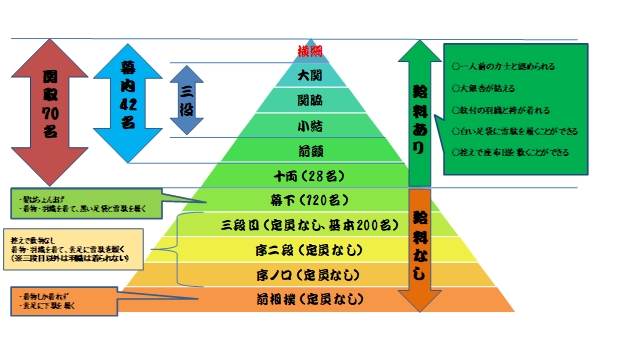
| Status | Division / Category | Rank (within division) |
|---|---|---|
|
Sekitori professional wrestlers in the top two divisions |
Makuuchi top division |
Yokozuna |
| Ozeki | ||
| Sekiwake | ||
| Komusubi | ||
| Maegashira | ||
|
Juryo second division |
Numbered positions | |
|
Rikishi Yosei-in trainee wrestlers in the lower divisions |
Makushita third division |
Numbered positions |
|
Sandanme fourth division |
Numbered positions | |
|
Jonidan fifth division |
Numbered positions | |
|
Jonokuchi sixth division |
Numbered positions | |
|
Banzuke-gai unranked category below Jonokuchi |
— |
* Ozeki, Sekiwake, and Komusubi are collectively called Sanyaku.
* In divisions below makuuchi, wrestlers are placed in numbered positions within each division rather than in separately named ranks.
Sumo Terms Used in This Section
- Banzuke (番付) – The official ranking list of all professional sumo wrestlers, announced before each tournament. It determines each wrestler’s rank and position for the next Grand Sumo Tournament.
- Sekitori (関取) – A fully fledged wrestler in the top two divisions, makuuchi and juryo. Sekitori receive a salary, enjoy much higher status and privileges, and are generally regarded as full professionals in the sumo world.
- Toriteki (取的) – An informal term used for wrestlers below sekitori rank. In some contexts, it is used especially for wrestlers in the very lowest divisions.
- Rikishi Yosei-in (力士養成員) – Trainee wrestlers in the lower divisions, from makushita downward. They are still working toward promotion to sekitori status and do not yet receive the status and privileges given to fully fledged wrestlers.
How the Banzuke Is Decided
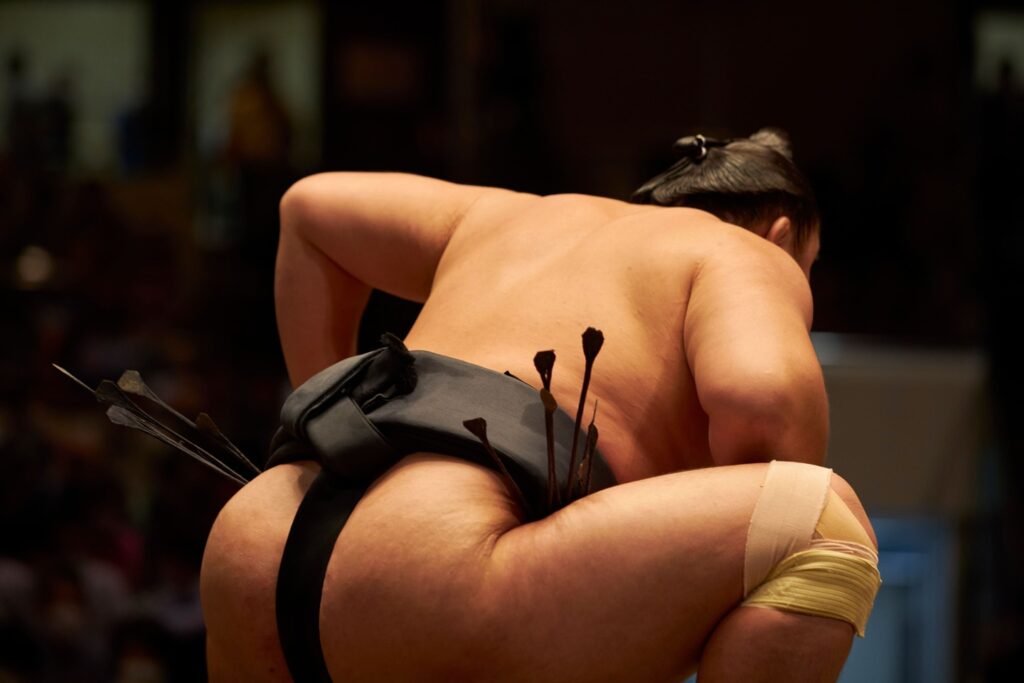
The banzuke is decided at the Banzuke Ranking Committee Meeting, which is held within three days after each Grand Sumo Tournament.
This meeting is made up of oyakata from the Judging Department of the Japan Sumo Association, with the head of the department serving as chair. Gyoji also attend as secretaries, but they do not have speaking rights.
Although the rule says “within three days,” the meeting is usually held on Wednesday, three days after senshuraku, the final day of the tournament, which is normally a Sunday. At this meeting, the results of all wrestlers are reviewed and the rankings for the next tournament are decided.
The new banzuke is usually announced 13 days before the opening day of the next tournament, and until then it is treated as strictly confidential. However, promotions to yokozuna or ozeki, which are formally conveyed by a messenger, are made public on the day of the committee meeting. The same is true for newly promoted juryo wrestlers, who need time to prepare their ceremonial aprons and other items. Since tournaments usually begin on a Sunday, this means the banzuke is generally announced on the Monday two weeks before the opening day.
In short, the banzuke is determined by the committee on the basis of the results from the previous tournament.
An ordinary scheduled bout during the tournament is called honwari. A playoff for the championship is not counted as a honwari bout. When two wrestlers finish with the same tournament record and then meet in a playoff, their official records are treated as equal for banzuke-making purposes.
As a rule of thumb, a wrestler with a one-win margin (8–7) may move up by one rank, while a three-win margin (9–6) may move up by three ranks. Conversely, a one-bout losing record may result in a drop of one rank, and a three-bout losing record may result in a drop of three ranks. Absences caused by injury are also counted as losses.
For example, a record of 7 wins, 3 losses, and 5 absences is treated as a losing record by one bout overall. In the lower divisions, where wrestlers fight only seven bouts in a tournament, even a one-bout difference can make a very large impact on the banzuke. A 4–3 record may lead to a big rise, while a 3–4 record may lead to a sharp drop. This tendency becomes even stronger in the lower divisions. Because the final ranking also depends on the results of surrounding wrestlers, many rikishi must wait anxiously for the announcement of the new banzuke.
A yokozuna, as the highest rank, cannot be demoted. However, if poor performance continues, the Yokozuna Deliberation Council may issue a recommendation to retire.
Expressions such as “No. 5” or “15th position” are used to show a wrestler’s place within a division, and the smaller the number, the higher the ranking. The very top position is called hittō, not simply “No. 1.”
A perfect record within the top 15 ranks of makushita is regarded as an especially important achievement and makes promotion to juryo in the next tournament highly likely. A perfect record in sandanme or below also gives a wrestler a strong chance of promotion to a higher position in the next tournament.
Sumo Terms Used in This Section
- Banzuke Ranking Committee Meeting (番付編成会議) – The meeting held after each tournament to determine the rankings for the next banzuke. The results of the tournament are reviewed there, and promotions and demotions are decided.
- Senshuraku (千秋楽) – The final day of a Grand Sumo Tournament. Because the tournament usually ends on a Sunday, the banzuke ranking committee meeting is generally held on the following Wednesday.
- Honwari (本割) – A regular tournament bout. Playoff bouts held to decide a championship are not counted as honwari when records are considered for banzuke-making purposes.
The Banzuke Sheet and Sumo Calligraphy
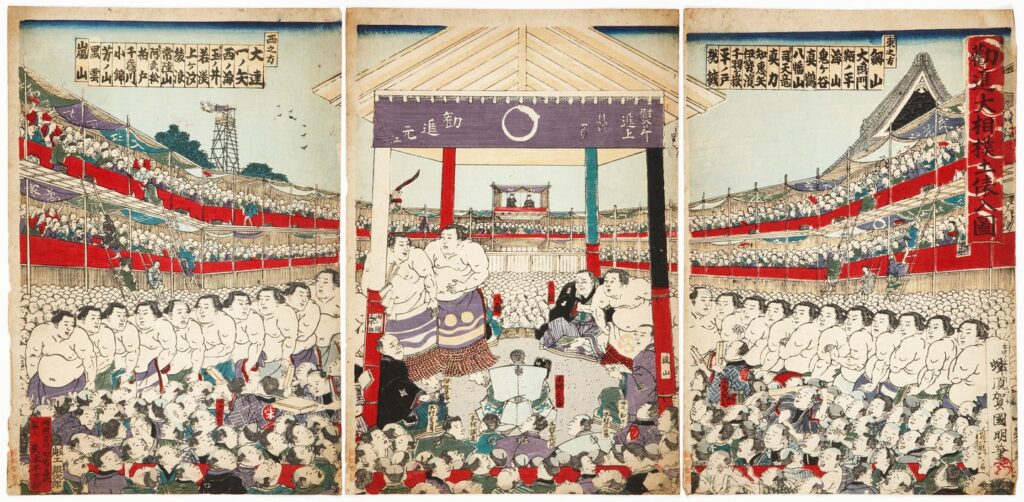
The word banzuke refers to the rankings themselves, while the banzuke sheet is the printed document that lists wrestlers, elders, gyoji, and others in order of rank. The original master copy is handwritten by a gyoji for each tournament.
This original copy is called the motogaki. It is written on a large sheet of stiff white drawing paper known in Japan as Kent paper, then reduced to about one quarter of its original size for public sale. In the earliest days, the East and West sides were printed separately, so the banzuke was sold as a set of two sheets.
In October 1757, during the Hōreki era, a one-sheet format like the modern banzuke appeared in Edo, and this style became standard in Edo sumo. In Kyoto and Osaka, however, the East and West sides continued to be printed separately until part of the Meiji period. As Edo sumo grew in popularity and influence, the one-sheet format eventually became the standard style used today.
Sumo Terms Used in This Section
- Banzuke-hyo / Banzuke Sheet (番付表) – The printed sheet that lists wrestlers, elders, referees, and other figures in the sumo world by rank. It is based on the official banzuke and is sold to the public as a traditional sumo publication.
- Motogaki (元書き) – The original handwritten master copy of the banzuke. It is written by hand by a gyoji and then reduced in size for printing and sale.
- Sumo-ji (相撲字) – The distinctive style of calligraphy used for banzuke sheets. Its thick, tightly packed strokes are said to express the wish that spectators will fill the venue with no empty spaces.
About Sumo-ji (相撲字)
The distinctive script used by gyoji on the banzuke sheet is called sumo-ji.
Its characters are written thickly and tightly, with almost no empty space. This style is said to express the wish that the venue, too, will be filled with spectators and leave no empty seats. Banzuke sheets have been issued since the Edo period, and from 1916 onward the writing of the banzuke was officially entrusted to gyoji.
How to Read a Banzuke Sheet
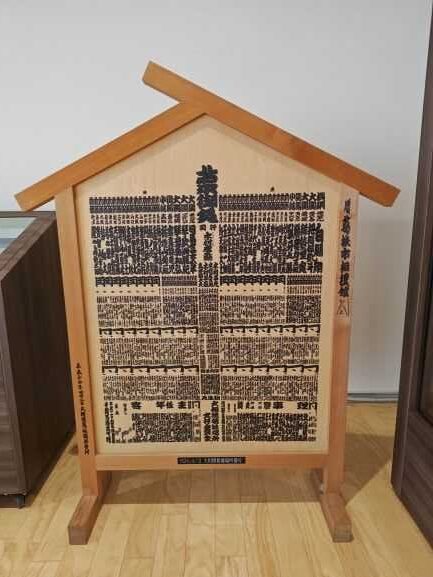
On a banzuke sheet, the higher the rank, the larger and bolder the writing. As the rank becomes lower, the size of the characters gradually becomes smaller and finer.
When looking at the banzuke sheet from the front, the wrestlers on the right-hand side are listed as East, and those on the left-hand side are listed as West. Starting with the yokozuna on the far right, the names are written in order toward the left. Wrestlers of similar strength are placed in symmetrical East and West positions. Although East and West are essentially equal, the East side is treated as slightly higher on the banzuke.
Vertically, the sheet is divided into five main sections. The top section contains the makuuchi wrestlers. The second section contains juryo and makushita. The third section contains sandanme. The fourth section contains jonidan. The fifth section contains jonokuchi, along with the names of elders, yobidashi, and other officials. Tokoyama are also listed to the left of the yobidashi, although only the special-class and first-class tokoyama appear there.
In the center of the sheet, the large characters “Mogomen / Gomen Komuru” are written in bold script.
Sumo Terms Used in This Section
- Higashi (東) – East. On the banzuke, the east side is slightly higher in rank than the west side when wrestlers hold the same position.
- Nishi (西) – West. On the banzuke, the west side is slightly lower than the east side when wrestlers are listed at the same rank.
- Tokoyama (床山) – A specialist sumo hairdresser who styles wrestlers’ traditional topknots. Only certain higher-ranking tokoyama are listed on the banzuke sheet.
- Yobidashi (呼出) – An usher and announcer who calls wrestlers to the ring, assists with ring maintenance, and helps support the smooth running of a tournament.
The Release Date and Purchase of the Banzuke Sheet
As noted above, the banzuke is usually announced 13 days before the opening day of the next tournament, and until then it is kept strictly confidential. However, promotions to yokozuna or ozeki, as well as promotions to juryo for wrestlers who need time to prepare their ceremonial aprons and related items, are made public on the day of the ranking committee meeting.
Because the opening day is usually a Sunday, the banzuke is generally announced on the Monday two weeks before the tournament begins, and sales of the printed banzuke sheet usually begin the following day.
As of the November 2023 tournament, banzuke sheets and hoshitori charts are not being sold at the Kokugikan for the time being. They are currently available only by mail order, and advance reservation is also possible. For the latest purchasing information, please check the official Grand Sumo goods page of the Japan Sumo Association.
Grand Sumo Goods – Nihon Sumo Kyokai(Japan Sumo Association)
Where to See a Wooden Banzuke Board
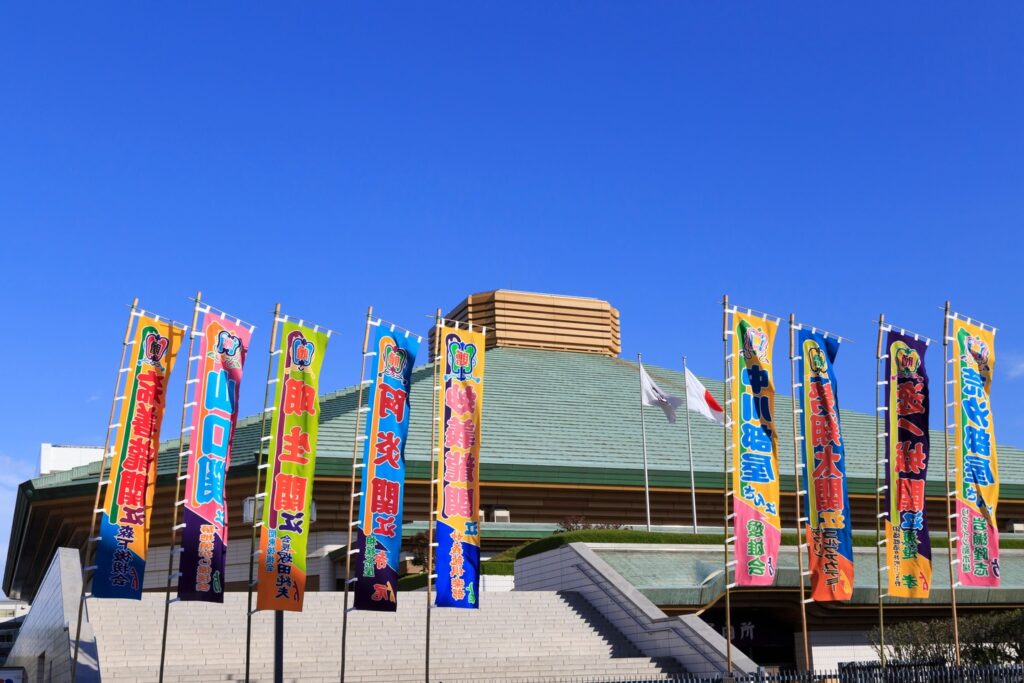
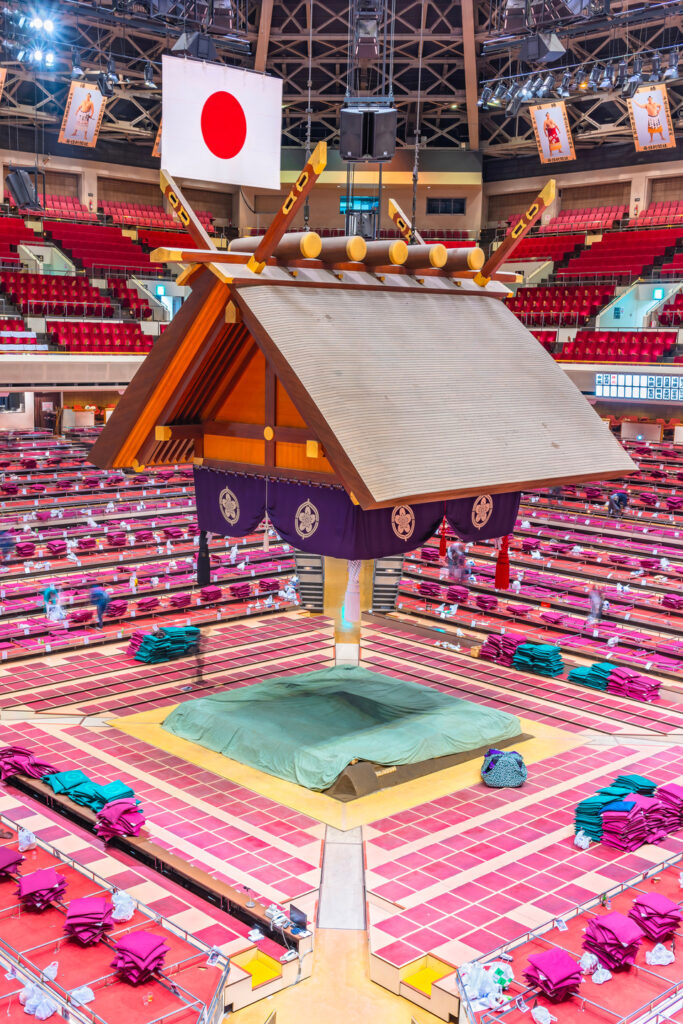
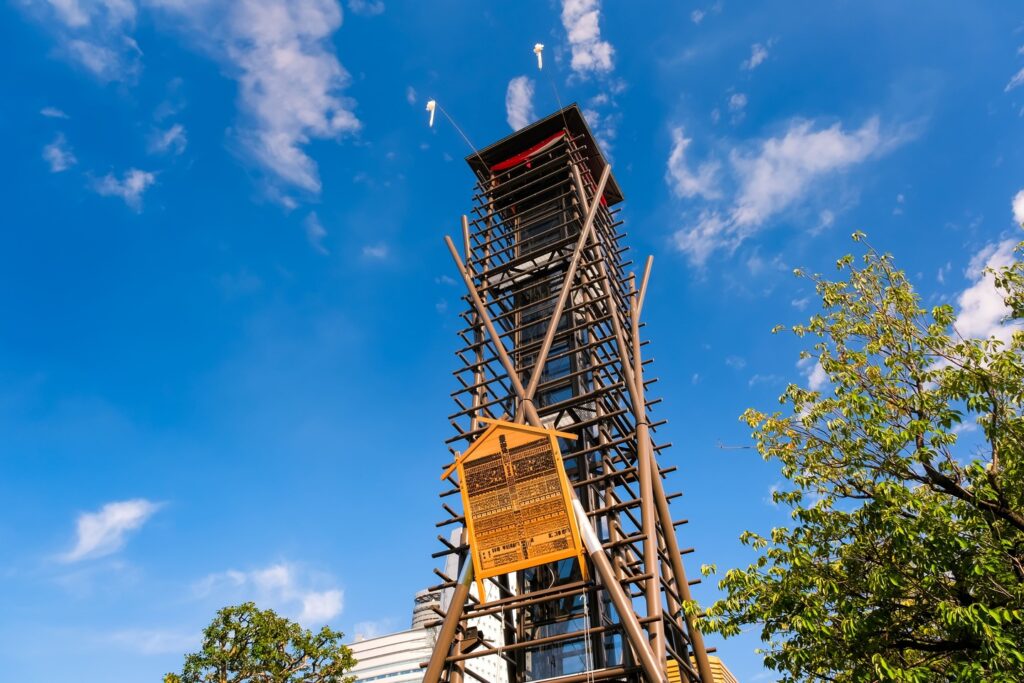
Before a Grand Sumo Tournament begins, a wooden signboard called an ita-banzuke is displayed near the entrance of Ryogoku Kokugikan in Tokyo, beside the yagura tower.
An ita-banzuke is a wooden board on which the banzuke is written in ink. It serves both as a public notice of the rankings and as a traditional form of promotion for the tournament.
The roof-like part above the ita-banzuke is arranged in the shape of the character 入 and is called iriyanegata. This design is said to express the hope for a full house. Like the printed banzuke, the ita-banzuke is also written by hand by a gyoji shortly before the tournament begins.
The Japan Sumo Association does not know exactly when ita-banzuke first began to be made. However, it is known that by at least the Genroku era (1688–1704), banzuke written in ink on wooden boards were already being displayed at the entrances of sumo venues.
Sumo Terms Used in This Section
- Ita-banzuke (板番付) – A wooden board displaying the banzuke. It serves both as a public notice and as a traditional form of advertising for the upcoming tournament.
- Iriyanegata (入屋根形) – A roof-like structure shaped like the character 入. It symbolizes the hope for a full house and is part of the traditional design of the ita-banzuke display.
- Yagura (櫓) – A tower-like structure set up near the venue entrance. At Ryogoku Kokugikan, the ita-banzuke is displayed beside this structure before a Grand Sumo Tournament begins.
What Does “Mogomen / Gomen Komuru” Mean?
The phrase written in large characters at the top center of the banzuke sheet is Mogomen / Gomen Komuru.
This traditional phrase, which appears at the top of both the printed banzuke sheet and the wooden ita-banzuke, indicates that official permission to hold the event was granted by the authorities. In the Edo period, sumo performances required authorization from officials such as the temple and shrine magistrates. The phrase remains on modern banzuke as a reminder of that historical custom.
Within Katsuragi City, ita-banzuke can be seen in two places: Katsuragi City Sumo Museum Kehayaza and the Katsuragi City Tourist Information Center.
The photograph below shows the ita-banzuke from the “Grand Sumo Katsuragi Basho” held in 2012, which is displayed at the Katsuragi City Tourist Information Center.
Sumo Terms Used in This Section
- Mogomen / Gomen Komuru (蒙御免) – A traditional phrase written at the top of a banzuke sheet or ita-banzuke. It indicates that official permission to hold the event was granted by the authorities, and remains on modern banzuke as a reminder of that historical custom.
Katsuragi City Sumo Museum Kehayaza Also Holds Genuine Ita-banzuke and Banzuke Sheets
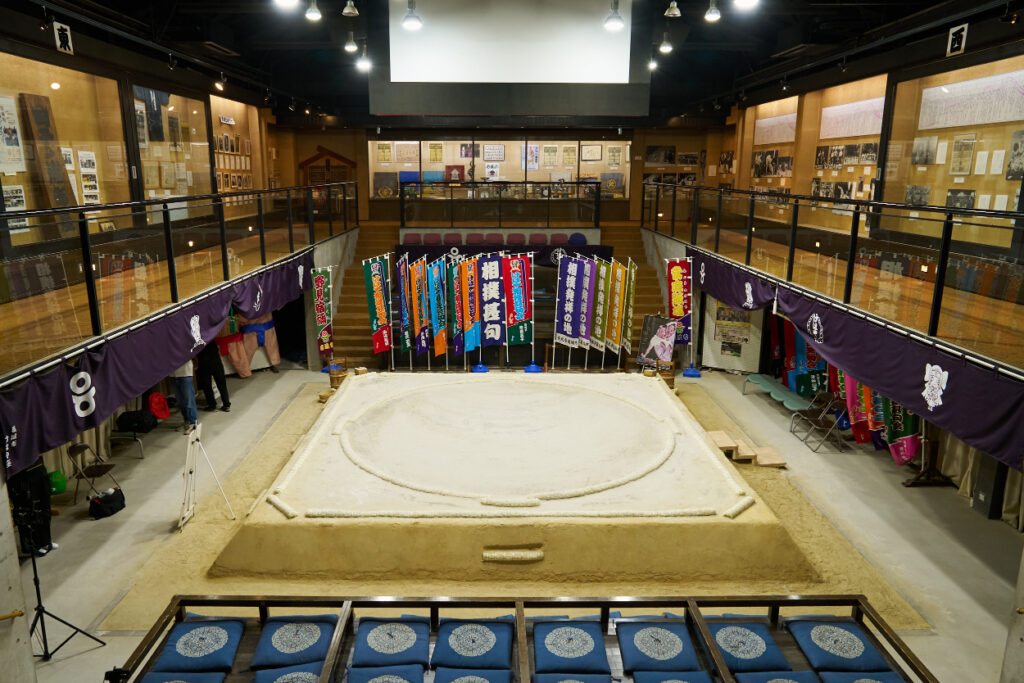
Katsuragi City Sumo Museum Kehayaza houses genuine ita-banzuke and printed banzuke sheets. The museum holds more than 12,000 sumo-related items, mainly donated materials, and displays around 1,000 of them at any given time.
About Katsuragi City Sumo Museum Kehayaza
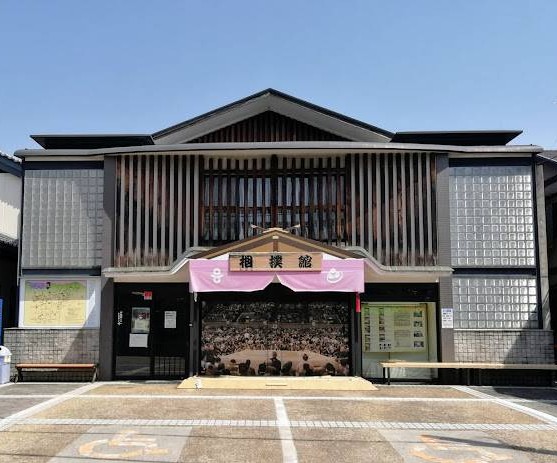
Katsuragi City Sumo Museum Kehayaza opened in May 1990 to honor Taima Nokehaya, who is traditionally regarded as the founder of sumo.
Inside the museum is a full-size dohyo built to the same dimensions as the ring used in Grand Sumo Tournaments. It is often visited by elementary school groups and is popular with visitors because, as an exhibition ring, it can be stepped onto freely.
The museum’s collection numbers about 12,000 items and includes books, banzuke sheets, hoshitori charts, and many other materials. These are often used by students writing reports and by sumo enthusiasts carrying out research. The museum also hosts special exhibitions from time to time.
The museum can also accommodate overseas group tours, school visits, and excursions. If you would like to visit as a group, please contact the museum in advance.
Opening hours: 10:00–17:00
Closed: Every Tuesday and Wednesday (open on public holidays)
Admission:
Adults (16 and over): 300 yen
Children (elementary and junior high school students): 150 yen
Preschool children: free
Group discount (20 or more):
Adults (16 and over): 250 yen
Children (elementary and junior high school students): 120 yen
Please check the official Katsuragi City website or related sources for the latest opening information, exhibition details, and visit arrangements.
About the Catalog “Katsuragi City Sumo Museum Kehayaza”
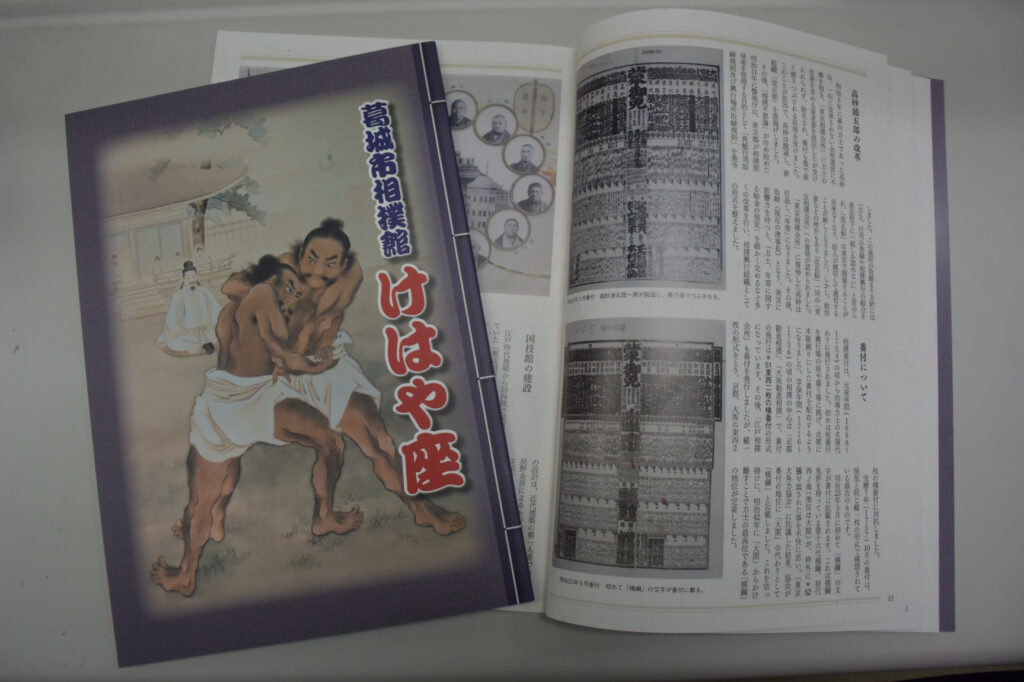
Katsuragi City Sumo Museum Kehayaza also publishes a catalog titled “Katsuragi City Sumo Museum Kehayaza.”
This catalog was published as part of the museum’s 30th anniversary project. It introduces the museum’s collection while also presenting the history and culture of sumo. Using materials from the museum’s holdings, it traces the story of sumo from its origins to the present day.
The catalog is available for purchase at the museum.
Price: 300 yen per copy (tax included)
Address: 83-1 Taima, Katsuragi, Nara
Telephone: 0745-48-4611
Key Sumo Terms in This Column
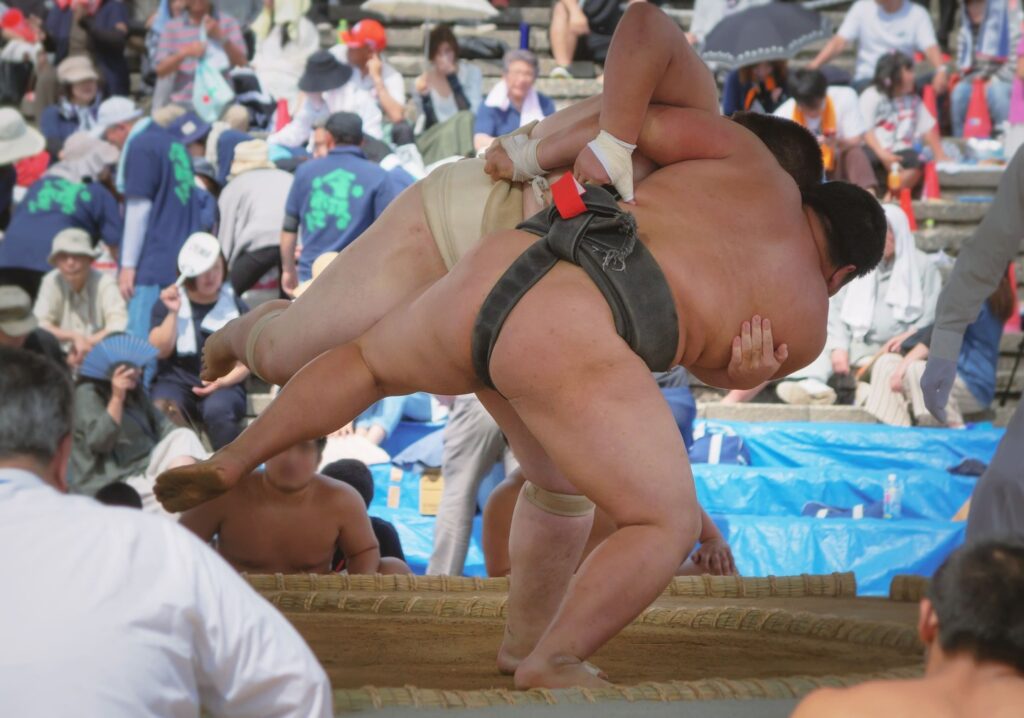
- Yokozuna (横綱) – The highest rank in professional sumo. A yokozuna is expected to combine outstanding strength with dignity and character worthy of the position.
- Ozeki (大関) – The second-highest rank in professional sumo. Wrestlers at this rank may be considered for promotion to yokozuna if they achieve exceptional results.
- Sekitori (関取) – A fully fledged wrestler in the top two divisions, makuuchi and juryo. Sekitori receive a salary and enjoy far greater privileges and status than lower-ranked wrestlers.
- Rikishi Yosei-in (力士養成員) – Trainee wrestlers in the lower divisions, from makushita downward. They are still working toward promotion to sekitori status and do not yet receive the status and privileges given to fully fledged wrestlers.
- Toriteki (取的) – An informal term used for wrestlers below sekitori rank. In some contexts, it is used especially for wrestlers in the very lowest divisions.
- Banzuke (番付) – The official ranking list of sumo wrestlers, announced before each tournament.
- Banzuke-hyo / Banzuke Sheet (番付表) – The printed sheet showing wrestlers and officials by rank.
- Kojo (口上) – A formal speech delivered at a wrestler’s promotion ceremony.
- Honwari (本割) – A regular tournament bout, not including a playoff for the championship.
- Senshuraku (千秋楽) – The final day of a Grand Sumo Tournament.
- Sumo-ji (相撲字) – The distinctive style of calligraphy used for banzuke sheets.
- Shimenawa (注連縄) – A sacred rope used in Shinto to mark off a sacred space.
- Yokozuna dohyo-iri (横綱土俵入り) – The special ring-entering ceremony performed only by yokozuna.
- Kataya-iri (方屋入り) – Another traditional name for the yokozuna ring-entering ceremony.
- Hinoshita Kaizan (日下開山) – An honorific nickname for a yokozuna, expressing unmatched greatness.
- Ita-banzuke (板番付) – A wooden version of the banzuke displayed near the venue before a tournament.
- Mogomen / Gomen Komuru (蒙御免) – A phrase indicating that official permission to hold the event was granted.